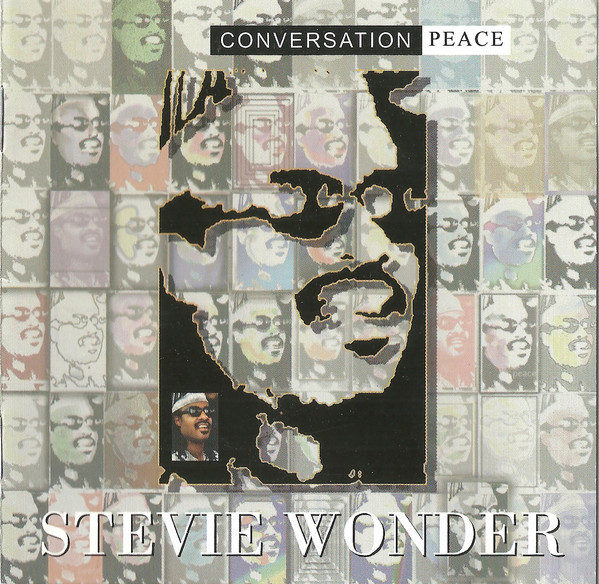
Stevie Wonder has never seen this album cover, which may be for the best.
According to a New Yorker article, Stevie Wonder began working on Conversation Peace in 1987. By this time Wonder was releasing music at a slower clip than his 70s output, and adapting to 80s pop styles by working with the latest in synthesizer technology. This would prove successful for him on tracks like 1984’s “I Just Called to Say I Love You” (his biggest hit ever), and 1985’s Billboard number 1 hit “Part-Time Lover”. Less successful and less talked about is the finished Conversation Peace album, which dropped not in the 80s but the same week I did in March 1995.
Multiple sources attest that Wonder wrote the entirety of Conversation Peace in Ghana, but this is apparently a country that Wonder first visited in 1993, years after he started working on the album. Whether or not most of it was written there, the country doesn’t seem to have a discernible impact on the music. Production wise, Stevie finds his New Jack Swing bag here, with opener “Rain Your Love Down” kicking things off like a Boyz II Men track, and a great one at that. “Edge of Eternity” is, despite its ominous title, an upbeat sex jam, with Wonder singing, “Girl I’m gonna hit it like it ain’t been hit before!” Damn!
My favorite song here is probably “Treat Myself”, a proto-self care anthem that bounces atop synthesized pan flutes and slap bass (ending with classic Stevie harmonica vamping). If that sounds like a lot, it kind of is, and you have to give yourself to the elastic 90s sound of the album to really enjoy it. The “Sorry” beat seriously sounds like a leftover from the Mario Kart 64 soundtrack. But these elements are also what makes Conversation Peace a forgotten gem in the Stevie Wonder discography. “My Love Is With You” has a chorus built in the model of “As”, from Songs in the Key of Life: rhythmic, circular and truly moving.
One thing that holds this album back from being a classic is the lyrical content. The album’s theme of peace is written with a sort-of “We Are the World” banality, as seen on the opening and closing tracks and this particularly awkward verse of “Take the Time Out”: “There’s a man in a house where they’re selling crack / Yet he’s trying to be strong / But when lost in the sea of no hope / He must be saved from wrong” What? Otherwise, you mostly have love lyrics that are either overly simplistic or clunky.
The album’s biggest and most enduring song, “For Your Love” is an accurate reflection of Conversation Peace as a whole. There’s a clunky verse in there: “A diamond that shines / Like a star in the sky / Is nothing to behold / For minuscule is any light / If it can’t, like you, brighten up my soul” But this is still a great song, no doubt, because it is wonderfully written musically, and Stevie Wonder is an incredible singer. It may not have all the genius of his greatest work, but there is little in recorded music that does, and Conversation Peace is worth a listen.
Listen to Conversation Peace here.




 good singing gum
