Album of the Week – Michael Naura’s Vanessa (1975)

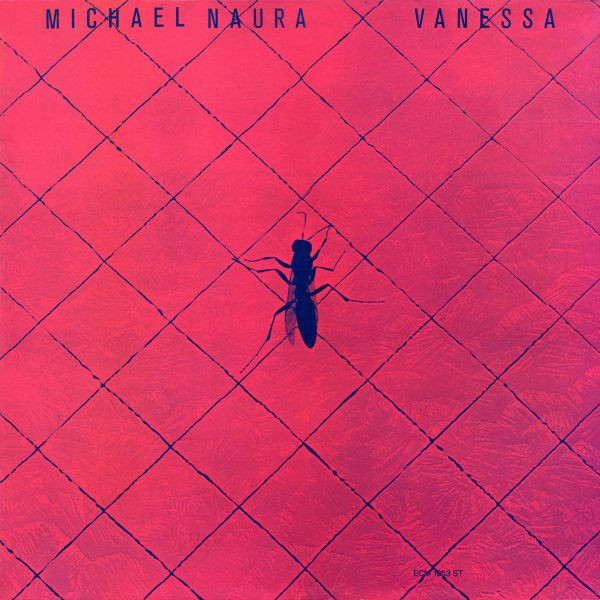
Recently I discovered Michael Naura Quartet’s Call (1973) and fell in love. Born in Lithuania, the pianist Naura moved to Germany and released music on the German label MPS. Call featured longtime bandmates Wolfgang Schlüter on vibraphone and Joe Nay on drums, as well as upright bass extraordinaire Eberhard Weber. For Vanessa, his ECM debut, Naura’s band is augmented to a quintet with a bassoonist in Klaus Thunemann.

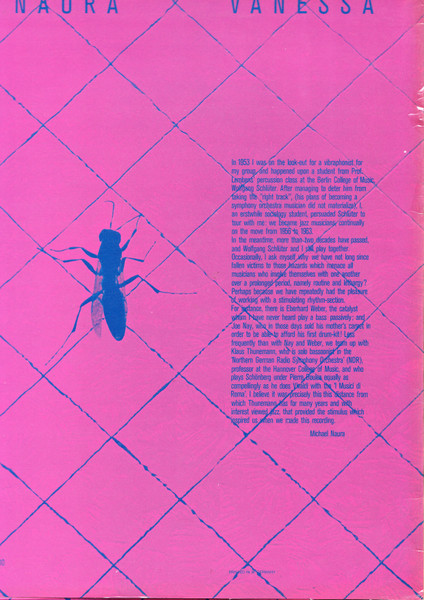
As Naura notes on the album’s back cover, he had by 1975 been playing jazz with Wolfgang Schlüter for two decades, and listening to several of their albums it is hard to understate the presence of Schlüter’s vibes, which seem to highlight Naura’s recordings more than even Naura’s own instrument. Still, Naura’s writing, presence as bandleader, and ability to establish the mood of his tracks is palpable. It is the element of this core duo, with Naura’s calm rhythms and Schlüter’s colorful leads, that makes Naura’s albums so compelling. Weber, the biggest name in the group, and Joe Nay, who according to Naura’s liner notes “[once] sold his mother’s carpet in order to be able to afford his first drum-kit,” fill out the rhythm section.

All that said, the first thing you really notice on Vanessa is a bassoon. Klaus Thunemann was a classical soloist and a Vivaldi specialist who really knew his way around the woodwind (and still does, I’m sure). His bassoon vamp over a murky groove on “Salvatore” makes the song a level-up from the band’s (bassoon-less) sound on Call. Around 8 minutes in, the drums drop out, and then Thunemann plays notes that sound like feedback. It’s amazing! After this nearly 12-minute opener, Weber, himself an ECM mainstay, spends most of the brief “Hills” just absolutely getting it in. “Vanessa” itself is a beautiful track – consisting mostly of just piano and vibraphone, it’s a reverie. Naura and Schlüter’s dynamic partnership is especially present on “Listen to Me”, where they really push each other. Thunemann’s track, the closer “Black Pigeon”, finds him rounding out the last 2 minutes of the record with eye-popping skill.

I believe this is the only recording of Naura or Schlüter with Thunemann, which is a shame, because he added another dimension to Naura’s band that makes Vanessa really superb. You can find some of Thunemann’s classical work here, and I also recommend the Naura Quartet’s spacier outing Rainbow Runner (1972).
Listen to Vanessa here.
Album of the Week: Roberta Flack’s Chapter Two (1970)

An artist must be relaxed and free of tension in order to record properly. -Roberta Flack, back cover of Chapter Two

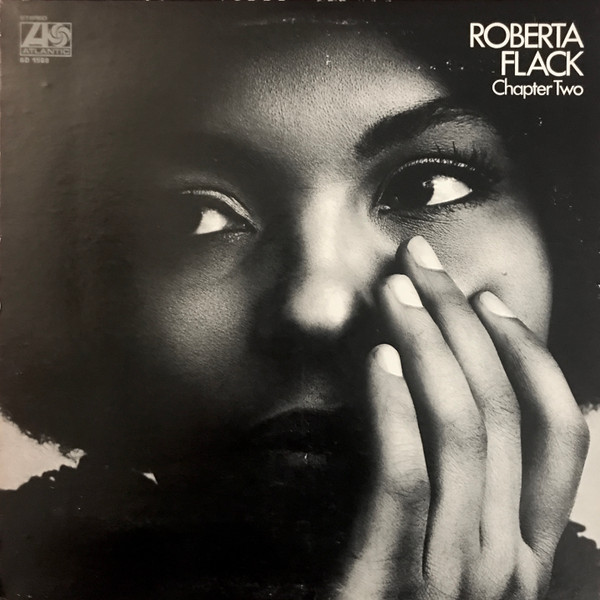
My first ever AOTW post (over three years ago now) covered Flack’s Feel Like Makin’ Love, a 1975 album that diverted from her earlier piano ballad style in favor of keyboards. But on Chapter Two, her sound was still relatively spare. Though not as popular as her debut First Take, Chapter Two is far from a sophomore slump.

We begin with “Reverend Lee”, a great tale of lust and faith. “Do What You Gotta Do” will sound familiar to fans of Kanye’s “Famous”, in which Rihanna sings the vocal part (West originally sampled Nina Simone’s version). “Let It Be Me” is so tender, it’s like The Everly Brothers’ version in slo-mo.

T.I.’s mammoth single “What You Know” samples this version of “Gone Away”, and listening to this album illustrates how brilliant Toomp’s sample is: he turned something wistful, almost mournful into an absolutely triumphant beat. Flack’s track itself wows in its graceful, beautiful buildup and release. The album should seemingly end with the climactic “The Impossible Dream”, but instead it finishes with the ominous war commentary “Business Goes on as Usual”. “Business Goes on as Usual” reminds me of Nico’s best work: its military march has an unsettling quality to it, and the spare arrangement allows the voice to take center stage. You can hear Flack breathing.

Chapter Two is ultimately a great showcase in Flack’s taste and form. She takes pop and folk songs (boy, Dylan was everywhere at this time) and makes them her own.

Listen to Chapter Two here.

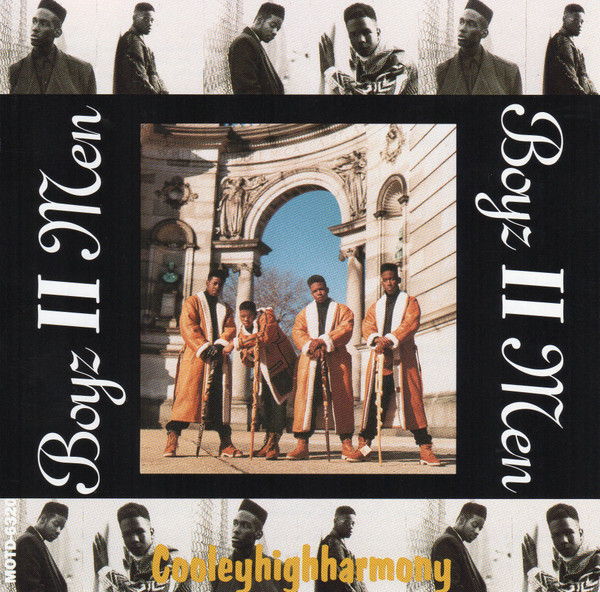
Album of the Week: Boyz II Men’s Cooleyhighharmony (1991)

Boyz II Men, ABC, BBD – the East Coast fam

So I knew the “BBD” was for Bell Biv Devoe (“Poison”), but I learned today that “ABC” stands for Another Bad Creation, a kid R&B group which I think I came across while practically studying Immature. I got this CD at some point in high school and it lived in the Honda Pilot. I also made “screwed” versions of “Please Don’t Go” and “Your Love”, both of which I jammed a lot.

Though not as consistent as its forebear Heart Break by New Edition (featuring “Boys to Men”, the song B2M named themselves after) or TLC’s CrazySexyCool (a spiritual successor by way of title if nothing else), there are some classic tracks here. They would go on to work with my R&B MVP Babyface later, but the Boyz peaked here on their debut with producer Dallas Austin at the helm. In 2016, Austin would tell Waxpoetics, “I went to Philadelphia with them to record “Motownphilly” and “Sympin’,” and they were the only two tracks I was going to produce for their album. When I got there, I clicked with the guys, they asked, ‘Why can’t you do our whole album?’ Then, they asked me, ‘Can you do ballads?’ So I went and bought some Babyface records to listen to them, and I figured out how to do ballads. I ended up doing their whole album.” So even though Babyface didn’t work on the album, his influence looms!

Working with Dallas Austin was a good idea! Opener “Please Don’t Go”, while never a big hit, is one of those songs I never tire of. Awash in 90s synth and robo-harpsichord, it’s sleeker than New Edition and a far cry from the textbook New Jack Swing of “Poison”. Saccharine, sure, but to me it’s perfect: the voiceover intro, the orchestra hits, and the harmonies that they’d come to be known for are all amazing. Then you have another sad song in “Lonely Heart” and two sexx jams in “This Is My Heart” and “Uhh Ahh” – which went number one! A pretty minimal, weird track to go number one, the production of which sounds really dated now (that makes it even cooler!).

This is the canonical version of “It’s So Hard to Say Goodbye to Yesterday”, which is either wistful or devastating depending on the context you use it in. Another strange hit! Almost acapella, and it went to number two on the charts. What can be said about “Motownphilly”: it’s a Motown classic, a Philly classic, a grocery store classic… just a banger.

There are some B-side gems in “Little Things”, where the production reminds me of the James Ferraro I was listening to in the early 2010s, and the fantastic, cloying closer “Your Love”. As opposed to Austin and the rest of the band, these were both written by Troy Taylor (who would later work with Trey Songz) and made by his production duo The Characters. But they fit right in. Also, “UR LOVE IS 2 HYPE” would be a good tattoo or bumper sticker I think.

Listen to Cooleyhighharmony here.

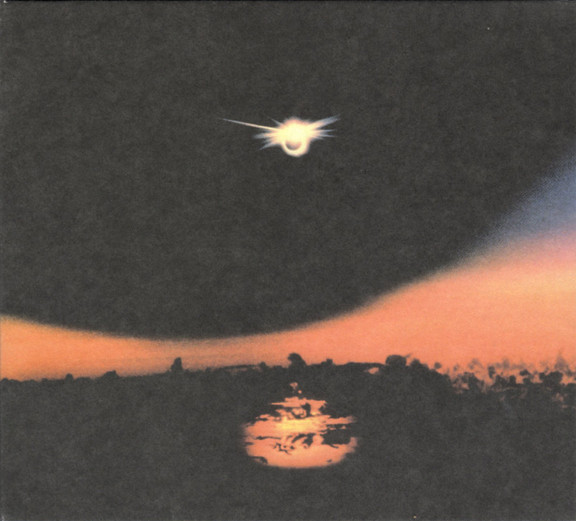
Album of the Week: Hatfield and the North’s The Rotters’ Club (1975)

rotter:

noun [ C ]

mainly UK old-fashioned

US  /ˈrɑː.t̬ɚ/ UK  /ˈrɒt.ər/

someone who is very unpleasant or does very unpleasant things

Synonyms

lowlife (informal disapproving)

stinker (old-fashioned informal)

-Cambridge Dictionary

A regular lot of rotters, these Brits! Hatfield and the North, hailing from Canterbury, were a sort of supergroup that released only two albums before disbanding. This one is a banger which I’ve been digging for a while, kind of a mix of British rock and jazzy prog. This release features Dave Stewart, who played organ on Arzachel (1969), which has one of my favorite songs ever, the organ-heavy “Queen St. Gang”. Various other members played in groups such as Caravan, Gong and Matching Mole (the outfit for drummer Pip Pyle, who wrote the two deep 7-minute pieces on side A of The Rotters’ Club).

The cover of Hatfield & The North, the band’s debut, depicts a serene photograph of Reykjavik, Iceland merged with a fresco of Dante’s Inferno. The implied combination of serenity and chaos is a good indicator of the band’s music, which will usually either stay light or else go in unpredictable directions. “Share It” provides an easy start to The Rotters’ Club with a nice pop vocal melody. Phil Miller flexes his muscle on the instrumental “Lounging There Trying” before the album really takes off. At about 2 minutes into “The Yes No Interlude” we get a gnarly Miller solo, the guitarist cleaning house before a quieter, spacey middle section. This space is mined even deeper towards the end of “Fitter Stoke Has a Bath”, a wacky venture.

The 22-minute suite “Mumps” accounts for the back half of this album, and it’s a deliciously jammy venture. At around 5 minutes the instruments meld together in a harmonious, guitar-led mix that, dare I say it, anticipates Phish by a decade or two. Then, the “Northettes” add some wordless vocals, before Stewart goes hardcore on his Minimoog, Miller providing some tasty psychedelic guitar licks. Sinclair’s vocal section is searching and a bit melancholy. There’s even some flute toward the end of this magnificent track, which finishes in triumph.

The back cover of The Rotters’ Club thanks “Heinz and The Tornados – For Musical Inspiration”. The Tornados’ output is certainly inspiring, as no instrumental group atop of the Billboard charts sounded quite like them then (check out 1962’s “Telstar”) or has since. Some 30 years after The Rotters’ Club, the Tornados’ music would also inspire Panda Bear, who sampled them on Person Pitch.

The reissue/streaming version of this album contains about 13 minutes of bonus material (including 2 live tracks!) that is worth your time. Put it up there with your favorite Soft Machine venture, it’s that good!

Listen to The Rotters Club here.

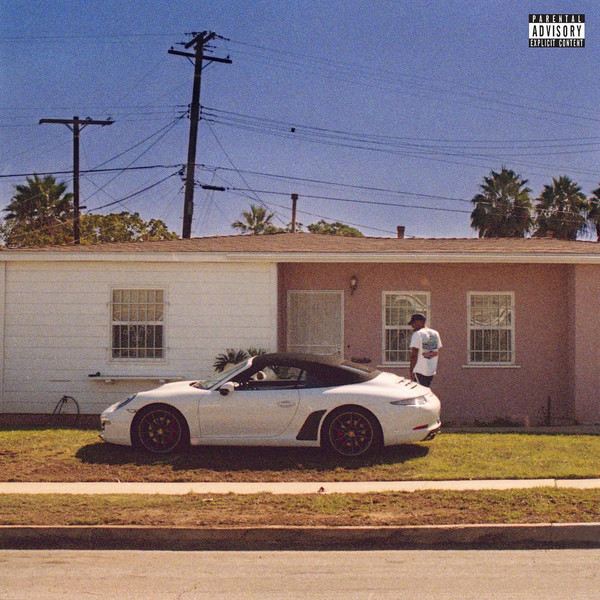
Album of the Week: Dom Kennedy’s Los Angeles Is Not For Sale, Vol. 1 (2016)

I’m not sure if Dom Kennedy would appeal to a hip-hop outsider: his flows are a little off-kilter; his rhymes often slow. But a couple of key early 2010s hip-hop moments helped me really appreciate this dude. The first is “Real Estates” from Curren$y’s Pilot Talk 2 (2010), an album that is (along with the preceding Pilot Talk) a benchmark for the kind of stoner rap music that doesn’t really exist anymore. “The game don’t get any realer” chirped Dom on his knot-tight “Real Estates” verse. Then 2012’s “Grooveline” (Schoolboy Q , 2012) verse showcased his relaxed playboy style, ending hilariously with a “Dom Kennedy” drop that sounds like a producer tag.

I never followed him enough to track a new release, but when Frank Ocean included “T P O” on his blonded radio it seemed like a good idea to check out this album. “T P O” is a mellow slap, immediately memorable for the beat’s harpsichord melody, but it’s also funny: “I was young, but I went to the Grand Canyon once / Now I’m at a stripper house makin’ tacos, rollin’ blunts.” The song exemplifies this album as a whole, which is Dom Kennedy at his best: a realist who is cool, confident and relatable, with fantastic production choices. Clearly following the mold of 90s LA g-funk, “Dominic, Pt. 2” updates the style with fantastic synth notes.

In college I fantasized about living in California and listening to “California”, and now I can finally do it. Something about the drums on this one… I would play this over and over again on my little wired earbuds walking around in the cold Pennsylvania winter daydreaming about life in Cali. “Wake up at 1:30, In-N-Out ‘fore it close / Catch me in the drive-thru, then spin out on these hoes.” Sounds like a good time, man… my plays of “California” dwarf the rest of the album.

I think sometimes Dom Kennedy is unintentionally funny or irreverent. Like, “Since We’re Telling the Truth” is ostensibly a love song, but the chorus ends with “I could have a statue downtown.” The lyrics “Even if I was starvin’ / I’m the type to pass on baloney / Walkman by Sony / I’m big as Tony, Toni, Tone,” read like Riff Raff bars, but they’re delivered earnestly over the heavenly beat of “When I’m Missin’ U”. Maybe it’s just the nostalgia, but I see these as pluses.

This album was not received well. You have to really dig Dom as a kind of normal-guy-who-likes-hanging-out if you want to sit through this whole record, which could be 3-4 tracks shorter. But revisiting it today it still strikes me as underrated.

Listen to Los Angeles Is Not For Sale, Vol.1 here.

Album of the Week: Mirrorring’s Foreign Body (2012)

In reviewing Grouper’s split release with Roy Montgomery from 2009 I described her “hazy, delicate and touching” sound, one that would carry into the 2010s successfully – including on this sole album from Mirrorring, the duo of Liz (Grouper) and Jesy (Tiny Vipers). This is, I believe, Grouper’s first release for Kranky (unless you count the digital premiere of “Fell Sound” a month earlier). At the time of its release Grouper’s output seemed like an embarrassment of riches (the double album AIA and the astounding “Water People” / “Moving Machine” 12″ had both been out less than a year) and I didn’t think too much of Foreign Body. Now I approach it like a Champion Sound of the contemporary ambient or folk scene: two greats in collaboration, switching off on lead vocals.

Truly, the Internet has broken my brain because the first word that comes to mind with this album is “goated”. I’ve yet to listen to it on good speakers, but I fear my mind and body might be transported to some far-away desert dimension and never return. In my taste for music that is unhurried, it seems the collaboration of Grouper and Tiny Vipers is the perfect recipe. Heavenly to start, Grouper takes vocals over a massive expanse of drone. It’s a bit surprising, though, that this was released as the album’s advance track and not “Silent From Above”. This is not a judgement of value, but Jesy’s vocals are far less murky than Liz’s, and her words much easier to parse. This suits the tighter “Silent From Above”, its bittersweet and blue guitars and vocals sounding like they were recorded outside by the campfire. “Cliffs”, the longest track here, is also the sleepiest, but it picks up a bit past the 5-minute mark.

Later, “Mine” proves the album’s climax – a huge drone with Jesy’s strong, melodic vocals. Boy if this doesn’t make you feel something. Towards the end the track appears to be eating itself, but then the monster reverb itself fades out, leaving little but space, with “Mirror of Our Sleeping” as a post-script.

Grouper followed Mirrorring with the Dragging a Dead Deer-era compilation The Man Who Died in His Boat (2013) and the sparse Ruins (2014). Tiny Vipers would later release an album of ambient excursions, Laughter, in 2017, which I find under-rated and is for some reason not on streaming services.

Listen to Foreign Body here.

Album of the Week: John Coltrane’s My Favorite Things: Coltrane at Newport (2007)

My latest musical obsession is John Coltrane playing “My Favorite Things”, something he did fairly often from the recording of the My Favorite Things album in 1960 up until his death in 1967. Coltrane breathed new life into the Sound of Music classic every time he touched it. This Public Radio Broadcast from 2010 outlines the history of Coltrane and “My Favorite Things” – in 1960 someone in a Lower East Side club gave Coltrane sheet music for the song (The Sound of Music was a hit Broadway play at the time and the movie version would not appear until 1965), and he brought it to his band. There are at least 18 commercially released versions of Coltrane playing the song, from the roughly 3-minute single to the mammoth 34+ minute recording on The Olatunji Concert: The Last Live Recording.

My *ahem* favorite version so far comes from the Newport Jazz Festival in 1963, one of two Newport sets (the other from ’65) featured on this album. A compilation of sorts, this particular disc features tracks that were largely previously released. Whether that picture of Coltrane ripping soprano sax on the cover is from one of these dates or not, it gives you a pretty good idea of what’s inside. The 1963 set eases in with Eckstine’s “I Want to Talk About You”. Expressive and warm, McCoy Tyner plays the perfect piano accompaniment to Coltrane, who solos with great confidence in the back half of the track. Then “My Favorite Things” clocks in around 17 minutes. Coltrane just punches the shit out of this thing. He’s fluttering, carrying the melody to new heights and pulverizing the theme. Around 16 minutes the exploration resolves into the theme in a turn that’s as brilliant as that of any jam band (I’m thinking of 2 in particular) might play decades later.

In some ways the gem of this disc is the inspired 23-minute “Impressions” following the title track, having only been previously released at a truncated 15 minutes. This track was good enough to warrant its own Coltrane album while he lived, and this take features a riled-up Roy Haynes on drums and cooks hard enough to earn its runtime.

You can tell, at the end of the 1965 take on “My Favorite Things”, that the crowd is loving it and has to be reminded of curfew by the announcer, who notes that “it’s the witching hour and time for all of you to go home” (maybe the band was cutoff?). I don’t think this version is quite as great, though it may at times stretch out a little further. To me it just doesn’t match the strength and aplomb of the 1963 version. Still, it’s one of the Greats doing what he does best, and tracking down Coltrane’s takes on this song is proving to be a rewarding past-time.

Listen to My Favorite Things here.

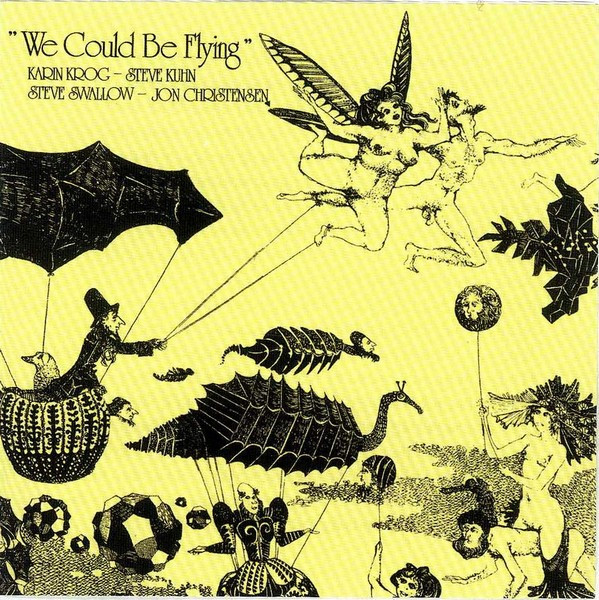
Album of the Week: Karin Krog’s We Could Be Flying (1974)

Oslo’s Karin Krog studied singing under Anne Brown, an American expat for whom George Gershwin wrote the music of Bess in Porgy and Bess. In 1964 she released her debut By Myself, which is the first female Norwegian vocal jazz record. Krog’s singing is lounge in presentation, but she has a masterful control of voice. When she really opens up two-and-a-half minutes into We Could Be Flying, you start to get a feel for her strength. And this is immediately followed by an instrumental vamp which speaks to the collaborative effort of this album.

Steve Kuhn, the American pianist who appeared on Pete La Roca’s classic Blue Note album Basra (1965), was living in Sweden at the time of this recording. He joins Krog here along with bassist Steve Swallow (also featured on Basra) and drummer Jon Christensen, who frequently recorded for the ECM label. Christensen really shines on “The Meaning of Love”, an early standout. This track has all the right kinds of space to it. Once again, Krog takes some pauses between her lines and the rest of the band stretches out.

The band does justice to Joni Mitchell’s “All I Want”, Krog’s delivery with more of a sly grin than Joni’s cracking despair. “Sing Me Softly of the Blues” (co-written by Carla Bley) has that old rainy Sunday in NYC vibe, mellow and jazzy – just the way I like it! The album closes with two Kuhn originals, the bass-driven “Hold Out Your Hand” and “Time to Go”.

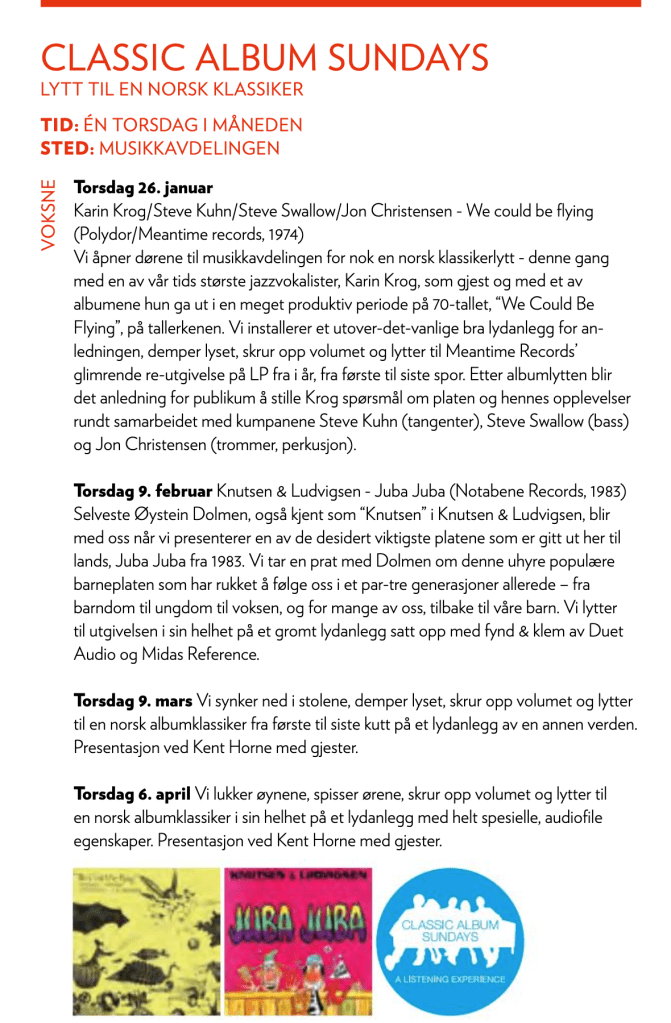
Also, in 2017, a library in Oslo played the album on audiophile equipment and Krog and Christensen were present to take audience questions. I wonder how that went! See the program flyer below – you may note that Knutsen & Ludvigsen’s Juba Juba (1983) was presented in this format 2 weeks later.

Listen to We Could Be Flying here.

Album of the Week: The Sea and Cake’s The Biz (1995)

Is Chicago underrated? Reading The Adventures of Augie March and listening to The Biz has me missing the Windy City, a feeling that was only amplified by a recent conversation I had with a gray-haired hipster dude at a Spellling show in Oakland. The guy was from Chicago and mentioned that Jeff Parker from Tortoise used to DJ some of the clubs he went to. Cue nostalgia for an era I never experienced!

Hipster mecca as it is (the home of Pitchfork!), Chicago in the early 90s found singer/guitarist Sam Prekop fronting the indie band Shrimp Boat. This great Pitchfork article notes that at the venue Lounge Ax in Lincoln Park, “Shrimp Boat played, according to [Doug] McCombs [of Tortoise], ‘this totally skronky, weird, idiosyncratic music with pop songs on top of it. They probably played like two shows a week and it felt like they were doing a completely new set of material each time they played.'”

When Shrimp Boat dissolved, Sam Prekop and SB bassist Eric Claridge formed The Sea and Cake with Tortoise’s John McEntire on drums and Archer Prewitt on guitar. Prekop hopped back into the local live circuit with the new band and they recorded and released three albums in the span of two years, The Biz being the third. Of the album, Prekop later said, “This one was recorded live, and I think we had worked out most of the tunes to play live, and that makes it different. We’d done shows with those songs before we’d put them on the record…and I think that’s the last time we worked that way… The way the songs arrived at that point was totally mysterious. Especially the song, ‘The Biz’… I still marvel at the bizarre chord progressions.”

Live and mysterious, yes, The Biz has that charming bookish 90s indie band style going for it from the jump. I’m surprised at how long it took for me to listen to The Sea and Cake given that I like them more than some of their contemporaries, other bands that are too dense/noisy or have bad vocals. Since you could apply the adjectives “chill” and “jammy” to a bunch of this, it makes perfect sense that I enjoy it. But I do think TSaC have an appeal broader than their popularity reflects, especially today when all their albums are available at the touch of a button. You could put on “Station in the Valley” at a laidback outdoor function and no one would bat an eye. And “The Transaction” resounds with the kind of sunny chords that populate some of the bigger Alex G songs.

That live recording/feeling Prekop mentioned translates here and the band sounds really tight. They’re also using EML-101 and ARP 2600 synths for an added dimension of sound. The band’s been labeled post-rock, but what they’re doing here doesn’t feel overly complicated or even dramatic. It’s not like it’s one-note either: “Darkest Night” is quite relaxing and “Escort”, two tracks later, is angular and noisy. File The Biz in with your overlooked indie rock records, and jam out.

Listen to The Biz here.

Album of the Week: Kool Keith’s Black Elvis / Lost in Space (1999)

I first discovered this one in 2016, and revisiting it recently I thought, “this is definitely the best thing Kool Keith’s ever done”. But then I was like, wait, Sex Style is really good… actually, The Cenubites is really good… actually, Critical Beatdown is REALLY good. And that’s not to mention any of the 25(!) or so albums Keith has released so far this millennium, most of which I haven’t heard. So you can’t really jump to a clear best with this guy.

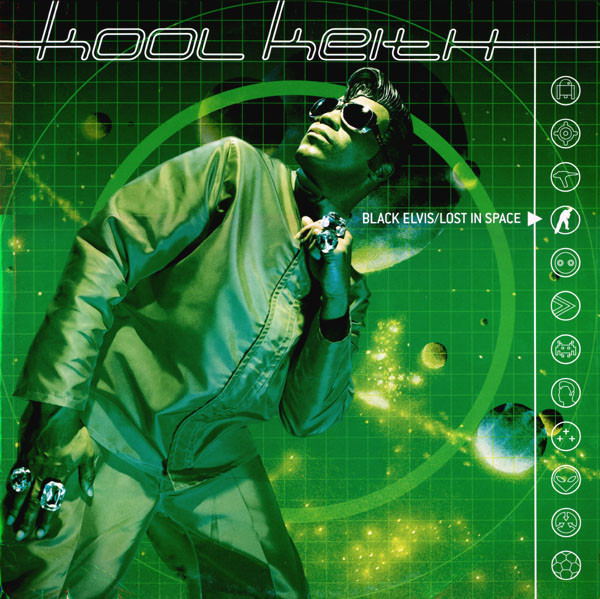
Keith was and always has been a trailblazer, and this is clear from the title and cover here alone. The damn Elvis wig… and with the flashy, turn-of-the-millennium neon green style this looks more like an N*Sync album cover than a rap record. But what lies within is hardly pop or R&B. It’s Keith’s signature bizzaro-rap, a two-sided journey through the mind of a hip-hop visionary.

Whereas Dan the Automator produced the bulk of Keith’s most popular Dr. Octagonecologyst (1996), Keith handles the production here himself (with frequent collaborator Kutmasta Kurt assisting). The result is a consistent and original sound, with enough synths and beeps to fit the space theme, but enough bass and kick to feel like pure hip-hop.

Keith’s rap style is wild because he has an effortless cool (he was well over a decade deep in the rap game by the time of this recording) but he’s also a weird motherfucker. “Keep it simple, baby young girl / Now squeeze your pimple,” he raps on “Static”. This Sadat X feature is great because Sadat is another OG who also has an idiosyncratic and funny style, like when he starts singing “our house in the middle of our street” in the middle of his verse. “The year 2005…” Keith begins on “Lost in Space”, which is more “Star Trekkin'” than any other rap song I can think of. These are just a couple of highlights early on.

As good as the Lost in Space side is here, I think I would give the win to Black Elvis, the second half of this record. Kid Capri sets it off, and then “Black Elvis” and “Maxi Curls” have some of the fastest rapping on the album, Keith dropping his Supreme Clientele-like stream-of-consciousness raps (except this album came first). “The Girls Don’t Like the Job” is one of the best examples of Keith’s uniqueness: his weird falsetto chorus and strange subject matter – “With a loan from General Mills I would start a new NBA team in Baldwin Hills: / The Baldwin Hills Spacemen / Lime green uniforms… I ripped up four tickets to the Grammy Awards”. “Clifton” features Keith’s perfect foil Motion Man, probably the only guy on his level of bizarre. No strangers to alter egos, they appear here as “Clifton Santiago” and “Keith Televasquez”, a duo of sex-crazed bandits. Things get rounded out with “All the Time” (one of the more straightforward tracks here) and “I Don’t Play”, which was lyrically interpolated by Deftones on “Back to School”, the first track on White Pony – this should probably tell you something about the reach of Kool Keith’s influence.

Three months ago, Keith released Black Elvis 2, a sequel 24 years in the making. I haven’t heard it, but he’s on tour now. By the time he plays San Francisco in October, he’ll be 60. For this year’s “Hip-Hop Turns 50” reflections, Kool Keith described himself as “a one-person Parliament-Funkadelic” to The New York Times. And like George Clinton, it’s amazing to look back at his wide body of work and marvel at the fact that he’s still doing it.

Listen to Black Elvis / Lost in Space here.