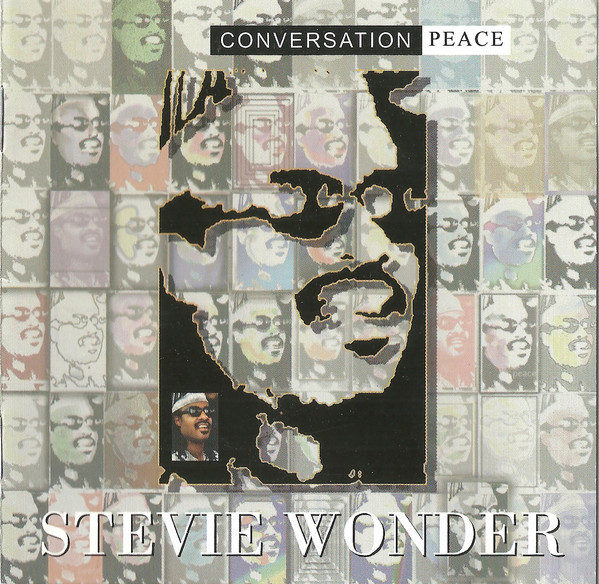
Album of the Week: Stevie Wonder’s Conversation Peace (1995)

Stevie Wonder has never seen this album cover, which may be for the best.

According to a New Yorker article, Stevie Wonder began working on Conversation Peace in 1987. By this time Wonder was releasing music at a slower clip than his 70s output, and adapting to 80s pop styles by working with the latest in synthesizer technology. This would prove successful for him on tracks like 1984’s “I Just Called to Say I Love You” (his biggest hit ever), and 1985’s Billboard number 1 hit “Part-Time Lover”. Less successful and less talked about is the finished Conversation Peace album, which dropped not in the 80s but the same week I did in March 1995.

Multiple sources attest that Wonder wrote the entirety of Conversation Peace in Ghana, but this is apparently a country that Wonder first visited in 1993, years after he started working on the album. Whether or not most of it was written there, the country doesn’t seem to have a discernible impact on the music. Production wise, Stevie finds his New Jack Swing bag here, with opener “Rain Your Love Down” kicking things off like a Boyz II Men track, and a great one at that. “Edge of Eternity” is, despite its ominous title, an upbeat sex jam, with Wonder singing, “Girl I’m gonna hit it like it ain’t been hit before!” Damn!

My favorite song here is probably “Treat Myself”, a proto-self care anthem that bounces atop synthesized pan flutes and slap bass (ending with classic Stevie harmonica vamping). If that sounds like a lot, it kind of is, and you have to give yourself to the elastic 90s sound of the album to really enjoy it. The “Sorry” beat seriously sounds like a leftover from the Mario Kart 64 soundtrack. But these elements are also what makes Conversation Peace a forgotten gem in the Stevie Wonder discography. “My Love Is With You” has a chorus built in the model of “As”, from Songs in the Key of Life: rhythmic, circular and truly moving.

One thing that holds this album back from being a classic is the lyrical content. The album’s theme of peace is written with a sort-of “We Are the World” banality, as seen on the opening and closing tracks and this particularly awkward verse of “Take the Time Out”: “There’s a man in a house where they’re selling crack / Yet he’s trying to be strong / But when lost in the sea of no hope / He must be saved from wrong” What? Otherwise, you mostly have love lyrics that are either overly simplistic or clunky.

The album’s biggest and most enduring song, “For Your Love” is an accurate reflection of Conversation Peace as a whole. There’s a clunky verse in there: “A diamond that shines / Like a star in the sky / Is nothing to behold / For minuscule is any light / If it can’t, like you, brighten up my soul” But this is still a great song, no doubt, because it is wonderfully written musically, and Stevie Wonder is an incredible singer. It may not have all the genius of his greatest work, but there is little in recorded music that does, and Conversation Peace is worth a listen.

Listen to Conversation Peace here.

Album of the Week: MJG’s No More Glory (1997)

Yes, one of the most whoa-inducing covers of 90s hip-hop, and it only gets wilder when you notice the little details: MJG’s baggy coat on the ground, his wild tips, nipple piercing, and long-ass fingernails. 8Ball & MJG are known more for their albums as a unit than their solo ventures, but both of their 90s solo projects are worth checking out. I’ve already covered 8Ball’s excellent Lost (1998), which was preceded by MJG’s No More Glory. Sometimes I wonder how good a 97 or 98 8Ball & MJG album would have been, because their collab tracks with each other on these solo efforts are among their greatest songs.

Take “Middle of the Night”, for example. 8Ball’s smooth flow on the first verse is a standout moment for him, and MJG’s chorus is addictive. The song reaches the upper echelon that Do or Die’s “Po Pimp” inhabits, so it’s only fitting that they tapped Twista for the remix. Elsewhere, “Shine & Recline” is a slap that would fit nicely on On Top of the World (1995), my favorite 8Ball & MJG album.

For his part, MJG’s solo tracks are largely excellent. “Hip Hop Voodoo” (“I’m throwin’ pepper in yo salt!”) finds him snapping over a crazy beat switch. A lot of the late-90s Suave House production is pretty dated, but it also has a really lovable quality, like it’s just silly enough to stand out and neither boom bap nor g-funk. “That Girl” is a re-work of the Stevie Wonder classic and was a hit. “Don’t Hold Back” is a straight-up great R&B crossover track, sort of bringing to mind early Darkchild production with a banging chorus. Amazing.

Despite its killer album cover, I don’t think that No More Glory has some grand political message – the title track is about the challenges of the rap industry and not racism. Nevertheless, the album has been in rotation and is better than I expected, which as a fan of 8Ball & MJG is saying something.

Listen to No More Glory here.

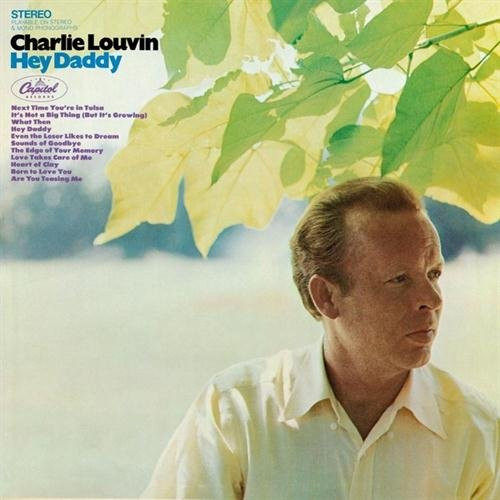
Album of the Week: Charlie Louvin’s Hey Daddy (1968)

The Louvin Brothers, Ira & Charlie, were successful gospel and country singers from the 1940s-60s. I know them from their 1959 album Satan Is Real, with its bonkers cover and excellent gospel harmony songs. Despite the heavy-handed preaching of the album’s lyrics, Ira was known as a womanizer and alcoholic, traits that led to the brothers’ break-up in 1963 (Ira died in a car crash 2 years later).

Hey Daddy, Charlie Louvin’s 7th solo album, follows a trend of eschewing the Louvin’s religious content, but it is no less wholesome. The title track finds the singer trading in the “bars and blondes” for fatherhood. Less wistful than the album cover might imply, “Hey Daddy” is instead a precious meditation on the simple joys children provide (though written by one Gene Chrysler, Louvin’s own son would have been about 13 at the time). The Louvins’ “Are You Teasing Me” rounds out side 1, a classic honky-tonk number.

Louvin’s voice is strong throughout the album – despite the lack of Ira, there are some great harmonies with the background vocals (I don’t have album credits for this one, unfortunately). He finishes with the Cindy Walker ballad “Born to Love You”. Charlie Louvin would continue to record and perform up to his death in 2011.

Listen to Hey Daddy here.

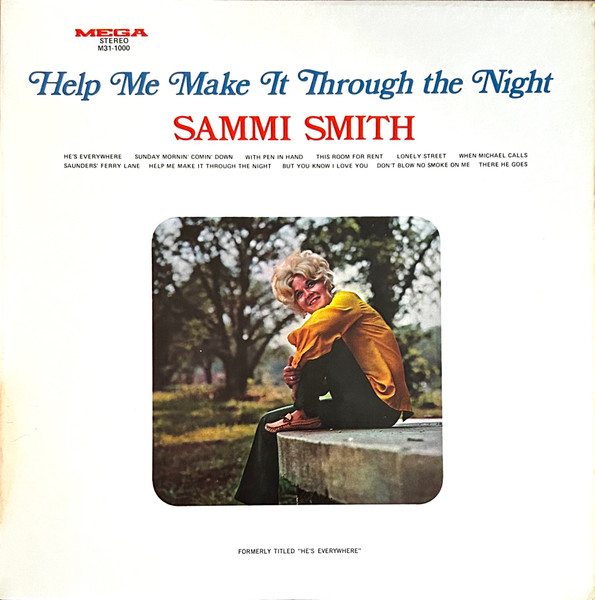
Album of the Week: Sammi Smith’s He’s Everywhere (AKA Help Me Make It Through the Night) (1970)

Country music has increased in popularity over the past few years, and so has my own interest in it. What used to be an appreciation for the hipster-approved Townes Van Zandt and Gram Parsons has extended to digging on Linda Ronstadt, Tanya Tucker, Nanci Griffith, Lyle Lovett etc. Safe to say I love me some Country! Sammi Smith was a name I didn’t know until recently, but her debut album He’s Everywhere blows me away.

Born in California, Smith once said of her childhood, “I moved around more than dust,” living in Oklahoma and Arizona. A friend of Waylon Jennings and Kris Kristofferson, Smith covers Kristofferson’s “Sunday Mornin’ Comin’ Down” and “Help Me Make It Through the Night” on He’s Everywhere, released on the short-lived Mega Records out of Nashville. He’s Everywhere, re-released as Help Me Make It Through the Night was Mega’s biggest hit, with the title track topping the Billboard Country charts.

The strings on opener “Saunders Ferry Lane”, paired with Smith’s smoky voice, create a cinematic atmosphere. The vibe is perhaps more torch song than classic Country. “There He Goes”, then, could be a Patsy Cline track. With vibraphones, steel guitar and a strong vocal take, it’s simply gorgeous. Kristofferson’s storytelling brilliance (not unlike that of Mickey Newbury, a favorite of Smith’s) shines through on “Sunday Mornin’ Comin’ Down”. This track captures the sort of Lonesome Country Blues vibe that the album succeeds in owning throughout. “He’s Everywhere” is a great and sorrowful song about not being able to get someone out of your head. “But You Know I Love You” and “Don’t Blow No Smoke on Me” are more straightforward Country tracks (the latter in the honky tonk vein), but the record is no worse off for that. He’s Everywhere ends abruptly during “This Room For Rent”, with an out-of-nowhere cut after the line “She’s heard no word from God, and nothing seems to matter anymore”.

After Mega folded, Smith signed to Elektra but was not well-promoted and seems to have never really gotten her due. She passed away in 2005 and is survived by her children, including her son Waylon Payne, a Country singer.

Listen to He’s Everywhere here.

Album of the Week: Ijahman’s Haile I Hymn (1978)

There are a few classic reggae albums that stand out for their deep atmosphere, song lengths, and spirituality. Dadawah’s Peace and Love (1974) comes to mind as a towering example. Another is Ijahman (Levi)’s debut Haile I Hymn, an inspiring record that is useful in turbulent times, no matter your religion.

Ijahman was born in Jamaica but released his first solo recordings in England in the late 60s as The Youth. These singles were a mix of R&B covers and Christian tunes that only hint at what he was capable of. After a prison stint in the early 70s, the man born Trevor Sutherland adapted Rastafarianism and released the single “Jah Heavy Load” as I. Jahman in 1976.

This and “I Am a Levi” caught the attention of Island Records with their deep grooves and Ijahman’s strong voice. The two tracks were reworked for his Island debut Haile I Hymn, and while roots purists might prefer the originals, the instrumental flourishes in the re-recordings add an all-star cast and a depth of feeling previously unattained. Rhythm stalwarts Sly & Robbie are here, as is Steve Winwood on organ. Guitarist “Bo Pe” Bowen (Three Piece Suit, Scientist Rids the World of the Evil Curse of the Vampires) plays a psychedelic lead, and is supported by rhythm guitar legends including Willie Lindo, who played on the aforementioned Peace and Love.

At just 4 tracks, Haile I Hymn begins with “Jah Heavy Load” in its reworked form. “I’ve got to carry Jah heavy load” goes the chorus, and it rings true today as everyone has their proverbial cross to bear. “I carry Jah heavy load / personally,” continues Ijahman on “Jah Is No Secret”, my favorite track here. The impassioned and melodic delivery of “personally” is incredible, as the band brings the track to an epic length. “Zion Hut” hits notes more saccharine than the rest of the album, but the organ’s church-like swells propel it toward transcendence early on. An extended vamp brings the track length to over 12 minutes. And the redone “I’m a Levi” has a new intro, and amazing singing.

Even with its extended tracks, Haile I Hymn never overstays its welcome. It’s both a touching work of devotion as a Rastafarian text and a chillout opus that will please any classic reggae fan or toking hippie.

Listen to Haile I Hymn here.

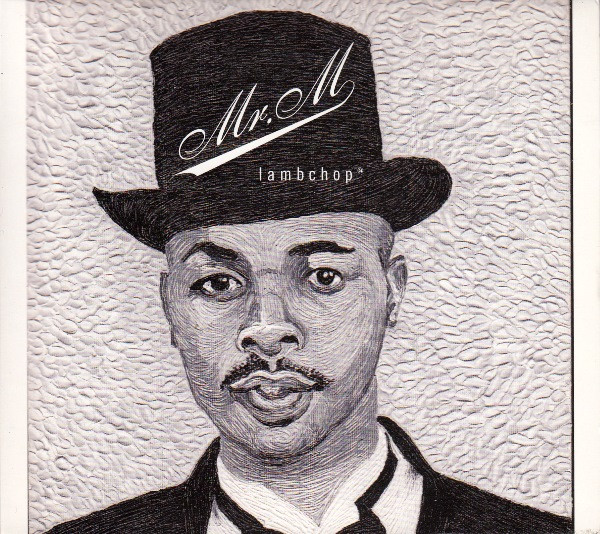
Album of the Week: Lambchop’s Mr. M (2012)

Driving to my 6AM grocery store shifts in the summer of 2015, Mr. M was an album I frequently listened to, needing something soothing and unhurried in my state of sleepy discomfort. My brother owned this CD (good choice, bro) so I took it with me in the car, sitting in there outside ShopRite drinking my coffee, smoking a cigarette on my breaks.

I never got over the perfection of opener “If Not I’ll Just Die” (the title cribbed from Bacharach’s “This Guy’s in Love With You”). Featuring “A London String Ensemble”, this song resonates with a calm beauty while exhibiting the wry humor that’s always been a part of Lambchop’s music. Lyrically, frontman Kurt Wagner seems to exist in and outside of the song: “crazy flutes” are mentioned, but never heard. Some lines seem to trail off (“maybe blowin’ kisses, blowin’ ?”), or are cryptic – “seagulls just avoid talk about seagulls,” or simple (“clean the coffeemaker”). I used to try to write these lyrics down from memory, and I’m still mesmerized by this song.

There is a heartbroken, bittersweet quality to much of this music. Singer and friend of the band Vic Chesnutt took his own life in late 2009, and Mr. M (recorded in the two years following) is dedicated to him. A line like “loss made us idiots” reflects the mental state of the band, again with dark humor. Really I never connected the impact of that event with the making of Mr. M until now, which is to say that the gloom of loss does not overpower the music. If anything there is a healing power in its soft delivery and smooth overtures.

Seasoned players create a slow atmosphere on many of these songs (see also: Is a Woman from 2002). But the meandering 10 minutes of “Gar” and “Nice Without Mercy” set “Buttons” in high relief. “I used to know your girlfriend / back when you used to have a girlfriend,” Wagner sings amid sad memories and observations. “Now she’s had another baby / and her life has gone suburban /And I wonder what she thinks of / when she thinks back now of you.” It’s hard not to read “Buttons” as a last letter to Chesnutt.

“It’s the kind of day you never wake up from,” begins “Kind Of”. This is Mr. M‘s big tearjerker, nestled between “Betty’s Overture” and the upbeat “The Good Life (is wasted)”. “Speak now love to me of your return,” sings Wagner in front of pleading strings. It’s the most tender moment on an album from a band that is usually as aloof as it is tender. In a discography loaded with great records, this is Lambchop’s masterpiece. Mr. M is a product of grief, but in its transfusion of pain it becomes a balm in itself, a work of magic.

Listen to Mr. M here.

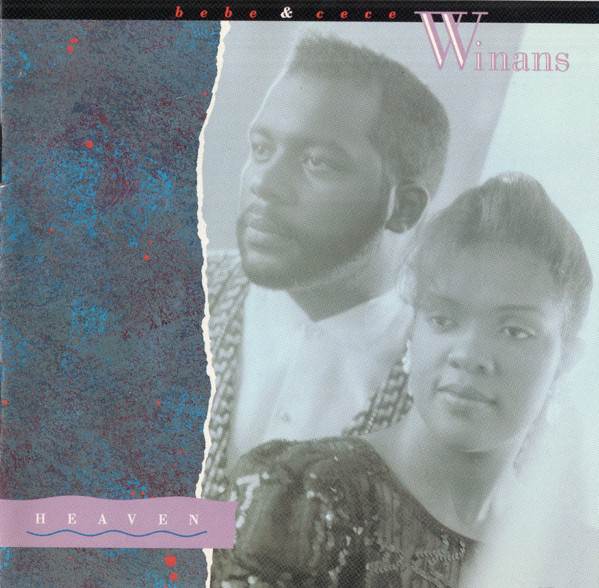
Album of the Week: Bebe & Cece Winans’ Heaven (1988)

The existence of God is a question that has been pondered by humans for millennia, and there is no definitive answer. It is a matter of personal belief and faith...

Ultimately, the question of whether God exists is one that each individual must answer for themselves.

-Google’s AI chatbot Gemini, in response to “is God real?”

Well, jury’s out on whether or not God is real. But Heaven definitely is! And its leadoff title-track is certainly heavenly. As “The White Cliffs of Dover” envisioned a post-WWII world of peace, Bebe Winans’ “Heaven” anticipates the celestial realm as a place where “there’s no more use for guns and war.” Over a beat that melds disco, processed Brazilian percussion, funky bass, and glass synth stabs, the brother-sister duo sing their gospel. It’s a masterstroke of pop-R&B and an ultimate 80s time capsule.

Keith Thomas, who later co-wrote Usher’s “Love in This Club”, takes the helm on the music side here, and not all of his tracks are as successful as “Heaven”. “Celebrate New Life” bores in comparison. “Lost Without You”, though, retains the synth magic. Winans’ lyrical odes to God are thinly veiled, but veiled enough that the choosy agnostic can enjoy this as a ballad of lost love. The Whitney Houston-featuring “Hold Up the Light” is another banger, with Bebe quoting the Pledge of Allegiance toward the end (probably the only song you can say that about).

The back half of Heaven is a little less interesting, but things close well with a cover of “Bridge Over Troubled Water” followed (on the CD/streaming version) by a 6-minute extended dub of “Heaven”. The Simon & Garfunkel cover is delightfully ethereal, and the “Heaven” remix is fun, if a bit of a mess. Overall, Heaven rides on the strength of its title track, with some other worthy tracks here and there.

Listen to Heaven here.

Album of the Week: T-Pain’s Epiphany (2007)

Tebunon… pedalophagus… from the planet Tallagoosa…

Can I get a witness? T-Pain is a Florida guy through-and-through (the T stands for Tallahassee), so he’s been on my mind this past month as Florida has battled two serious hurricanes. We all know “Bartender” and “Buy U a Drank”, but is the rest of T-Pain’s second album worth a listen? Yes, yes it is.

Epiphany was produced entirely by T-Pain, whose smooth production holds up some 17 years later. Shawnna (“What’s Your Fantasy?”) provides the assist on “Backseat Action”, a song about fucking on the highway which is far from the weirdest sex song on here. You know that saying, “he could sing the phone book”? That’s T-Pain. He has a whole song about the sexual appeal of… stomachs, and it sounds great. Yes, “Yo Stomach” is a real song. It’s absurd, it’s funny, it’s catchy. “Them crunches got me punchin’ the wall!” Change the lyrics to being in the club or falling in love or something and you have a hit. But I love that Pain stuck with his weird fetish song instead. I don’t think I have to explain what “69” is about, but it is NSFW.

“Time Machine” is my favorite T-Pain deep cut because it strikes a brilliant balance between humor and heartfelt emotion. In it, he reminisces on the ease of his life before fame. In his signature auto-tune he coos, “No matter how bad the weather, everything back then was just so better,” followed by a wistful “heh”, as if acknowledging the bastardized syntax. It’s not the only combination of humor and emotion from Pain, whose closer “Sounds Bad” is an over-the-top look at the struggles of the little guy, a la Justin Timberlake’s “Losing My Way”.

T-Pain raps with a tight flow on “Show U How”, proving himself a one-man hit machine. He rap, he sing… and anyone who doubts his ability as a singer (what with all the autotune) need only peep his Tiny Desk Concert, which is my favorite of the series. It’s a thing of beauty. But back to Epiphany. Yeah, it’s not without a few skips, but really it’s an excellent album by a national icon, with surprisingly human moments. I’d recommend it to any fan of pop music.

Listen to Epiphany here.

Album of the Week: Air’s Air Song (1975)

Henry Threadgill has an immense and under-appreciated discography, with a particularly magic run of recordings in the 90s. Digging back into an earlier era, though, reveals gems that may be the best entry point for a jazz fan unaccustomed to his distinct style. As a founding member of the trio Air, originally convening in 1972 and then performing and touring as Reflections (before changing that name), he focused on playing as part of a collective. Still, Threadgill wrote the music for the trio’s first record, Air Song, produced and recorded by the Japanese label Whynot.

I’ve lost count of how many times I’ve listened to this album, but I still find new things in it. In a way, Threadgill’s music defies categorization (let alone written commentary), circling around post-bop, military march, free jazz, ragtime and other modes without being pigeonholed into a style. Air Song begins in a fairly straightforward manner, but Fred Hopkins’ nearly 3-minute bass solo on opener “Untitled Song” pushes the track toward the sublime. This may be Threadgill’s first great recorded opus. “Great Body of the Riddle” then explores a much looser and more avant-garde rhythm, this time with a Steve McCall drum solo that clears up some space for Threadgill’s sax to rip it apart.

On the B-side are “Dance of the Beast” and “Air Song”. “Dance of the Beast” comes out swinging with the most intense sax playing on the album, but makes for a great boost at work. Threadgill’s flute opens “Air Song”, deftly navigating hollow space. Hopkins’ bowed bass then adds a sweetness to the sonic dimension. Bells are eventually added to the percussive mix before things round out, resulting in the album’s quietest and, for lack of a better word, airy track. Air would continue touring and recording for another decade or so before disbanding. More information can be found in Threadgill’s wonderful memoir “Easily Slip Into Another World”.

Listen to Air Song here.

Album of the Week: Coco & Clair Clair’s Sexy (2022)

As we experience the Braternization of pop music (it was only a matter of time), I’d like to look back a ways to one of the most fun pop albums of our era. And when I say “back a ways”, I mean 2022, because time moves fast in music.

I first heard Coco & Clair Clair in 2019 on Deaton Chris Anthony’s “RACECAR”, then discovered their immaculate song “Pretty”. The girlies enlisted Kreayshawn on their 2020 song “TLG”, thereby showing some love to a forebear of their sound and style. It’s a fantastic track that cemented my place as a fan. Sexy, then, turned out to be about everything I hoped for in a C&CC album.

The first few tracks follow the group’s established style: candy-coated beats, Coco’s humor and Clair Clair’s dream-pop melodies. “The Hills” is like the musical equivalent of a Kirby plushy, and “U & Me” is a doe-eyed Britney tribute. “8AM” throws a curveball by going sunshine pop, while “Bitches” enlists the help of niche west coast rapper Marjorie W.C. Sinclair, with a rare and thrilling Clair Clair rap verse (“The Louis, the prada? / both mine / Your man and his friend? / both mine / Kissin’ my ass / full-time”). It’s a burst of serotonin that makes for one of my most-listened to tracks on the album.

“Lamb” taps indie artist Porches for some slacker guitar and proves another highlight. meltycanon’s toy music box beat for “TBTF” works perfectly for Coco & Clair Clair’s carefree approach, and there’s a hilarious slideshow video (see above). Single “Pop Star” rounds things out, appropriately, as the album’s most popular song. Coco & Clair Clair recently followed this one up with Girl, which plays more like an EP at 24 minutes, but is also worth a listen.

Listen to Sexy here.