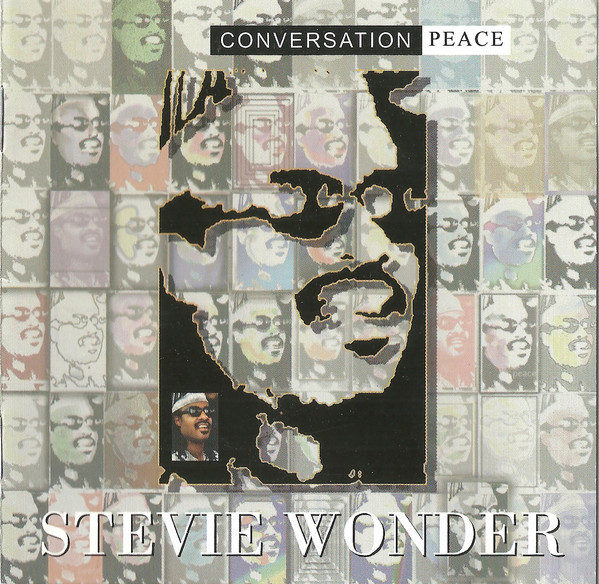
Album of the Week: Stevie Wonder’s Conversation Peace (1995)

Stevie Wonder has never seen this album cover, which may be for the best.

According to a New Yorker article, Stevie Wonder began working on Conversation Peace in 1987. By this time Wonder was releasing music at a slower clip than his 70s output, and adapting to 80s pop styles by working with the latest in synthesizer technology. This would prove successful for him on tracks like 1984’s “I Just Called to Say I Love You” (his biggest hit ever), and 1985’s Billboard number 1 hit “Part-Time Lover”. Less successful and less talked about is the finished Conversation Peace album, which dropped not in the 80s but the same week I did in March 1995.

Multiple sources attest that Wonder wrote the entirety of Conversation Peace in Ghana, but this is apparently a country that Wonder first visited in 1993, years after he started working on the album. Whether or not most of it was written there, the country doesn’t seem to have a discernible impact on the music. Production wise, Stevie finds his New Jack Swing bag here, with opener “Rain Your Love Down” kicking things off like a Boyz II Men track, and a great one at that. “Edge of Eternity” is, despite its ominous title, an upbeat sex jam, with Wonder singing, “Girl I’m gonna hit it like it ain’t been hit before!” Damn!

My favorite song here is probably “Treat Myself”, a proto-self care anthem that bounces atop synthesized pan flutes and slap bass (ending with classic Stevie harmonica vamping). If that sounds like a lot, it kind of is, and you have to give yourself to the elastic 90s sound of the album to really enjoy it. The “Sorry” beat seriously sounds like a leftover from the Mario Kart 64 soundtrack. But these elements are also what makes Conversation Peace a forgotten gem in the Stevie Wonder discography. “My Love Is With You” has a chorus built in the model of “As”, from Songs in the Key of Life: rhythmic, circular and truly moving.

One thing that holds this album back from being a classic is the lyrical content. The album’s theme of peace is written with a sort-of “We Are the World” banality, as seen on the opening and closing tracks and this particularly awkward verse of “Take the Time Out”: “There’s a man in a house where they’re selling crack / Yet he’s trying to be strong / But when lost in the sea of no hope / He must be saved from wrong” What? Otherwise, you mostly have love lyrics that are either overly simplistic or clunky.

The album’s biggest and most enduring song, “For Your Love” is an accurate reflection of Conversation Peace as a whole. There’s a clunky verse in there: “A diamond that shines / Like a star in the sky / Is nothing to behold / For minuscule is any light / If it can’t, like you, brighten up my soul” But this is still a great song, no doubt, because it is wonderfully written musically, and Stevie Wonder is an incredible singer. It may not have all the genius of his greatest work, but there is little in recorded music that does, and Conversation Peace is worth a listen.

Listen to Conversation Peace here.

Album of the Week: The Sylvers II (1973)

Some soul groups live in relative obscurity despite their fantastic music. Enter The Sylvers: supremely 70s, afros so large on this album cover that it becomes hard to tell where one ends and the next begins. Leon Sylvers III, up there in the top-right corner, was the brainchild of this Watts (LA) family act, writing most of their songs. Their early albums have provided legendary sample fodder and are killer soul LPs in their own right.

The small-time MGM subsidiary label Pride, who also released the probably unauthorized The History of the Grateful Dead album, signed The Sylvers in the early 70s for a string of soul records. By the time Pride folded in 1975, The Sylvers were recording for Capitol and had moved in the disco direction (their biggest hit, “Boogie Fever”, was released the same year).

Sylvers II features outstanding arrangements from David Crawford. The ballad “I’ll Never Let You Go” is both groovy and spooky. The string and horn arrangements on “Cry of a Dreamer” are beautiful and vault the song from good to great territory. B-side opener “Stay Away From Me” is bold and biting, and was sampled prominently on Ghostface Killah’s “Be Easy”. This song was also (perhaps strangely, since album-opener “We Can Make It If We Try” has more pop potential) released as a single by both Pride and MGM, with a contrasting B-side of the chill The Sylvers (1972) cut “I’ll Never Be Ashamed”, a harpsichord-laden groove.

“I remember when it was yesterday,” goes the chorus of the wistful “I Remember”, before the album closes, appropriately, with a cover of The Beatles’ “Yesterday”. This a capella cover is the most unique track on the album, showcasing the group’s full vocal range and plumbing the depths of the oft-covered song’s sorrowful melody. Though the “I Remember (Yesterday)” > “Yesterday” combo closes the chapter on The Sylvers II, The Sylvers would remain recording consistently until disbanding in the mid-80s. While they reunited for a live performance in 2017, it is unclear to me what the future holds for this overlooked group.

Listen to The Sylvers II here.

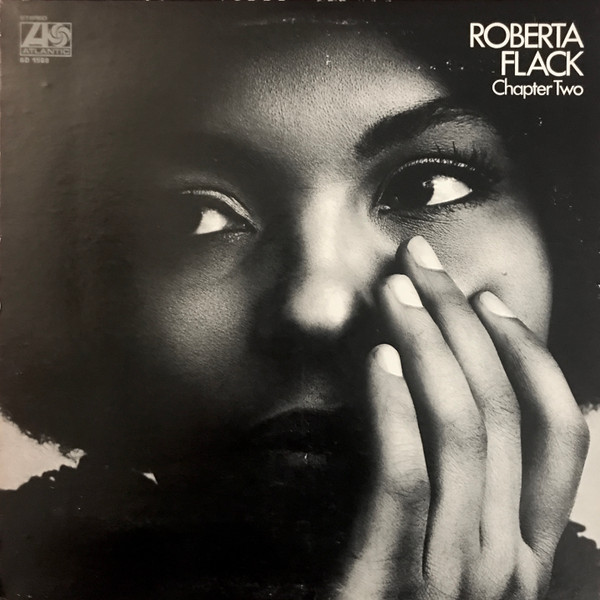
Album of the Week: Roberta Flack’s Chapter Two (1970)

An artist must be relaxed and free of tension in order to record properly. -Roberta Flack, back cover of Chapter Two

My first ever AOTW post (over three years ago now) covered Flack’s Feel Like Makin’ Love, a 1975 album that diverted from her earlier piano ballad style in favor of keyboards. But on Chapter Two, her sound was still relatively spare. Though not as popular as her debut First Take, Chapter Two is far from a sophomore slump.

We begin with “Reverend Lee”, a great tale of lust and faith. “Do What You Gotta Do” will sound familiar to fans of Kanye’s “Famous”, in which Rihanna sings the vocal part (West originally sampled Nina Simone’s version). “Let It Be Me” is so tender, it’s like The Everly Brothers’ version in slo-mo.

T.I.’s mammoth single “What You Know” samples this version of “Gone Away”, and listening to this album illustrates how brilliant Toomp’s sample is: he turned something wistful, almost mournful into an absolutely triumphant beat. Flack’s track itself wows in its graceful, beautiful buildup and release. The album should seemingly end with the climactic “The Impossible Dream”, but instead it finishes with the ominous war commentary “Business Goes on as Usual”. “Business Goes on as Usual” reminds me of Nico’s best work: its military march has an unsettling quality to it, and the spare arrangement allows the voice to take center stage. You can hear Flack breathing.

Chapter Two is ultimately a great showcase in Flack’s taste and form. She takes pop and folk songs (boy, Dylan was everywhere at this time) and makes them her own.

Listen to Chapter Two here.

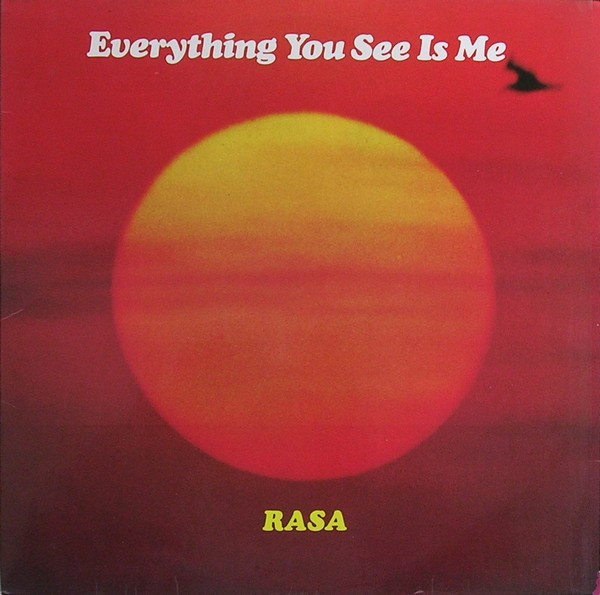
Album of the Week: Rasa’s Everything You See Is Me (1978)

One of my first posts on this blog was Roberta Flack’s Feel Like Makin’ Love, featuring the classic title-track penned by Eugene McDaniels. McDaniels’ own album Headless Heroes of the Apocalypse (1971) is superb and worth checking out. 7 years after Headless Heroes, McDaniels’ sons fronted Rasa, a Krishna Consciousness-informed funk/soul band. I touched a bit on the popularity of Vedic religions in the 70s and their influence in music in my review of Alice Coltrane’s Kirtan: Turiya Sings. Coltrane, then known as Swamini Turiyasangitananda, is thanked on the liner notes of Everything You See Is Me.

According to the folks at In Sheep’s Clothing, “Chris and London McDaniels wandered into a Krishna Consciousness event one fateful afternoon and met leaders of the Krishna movement, who soon found out that the brothers made music, and asked the pair to produce an album of catchy pop music to promote the ideas to English speaking audiences,” leading to the Rasa album, seemingly a one-time thing. ISKCON (International Society for Krishna Consciousness) Inc. released the album in 1978 along with another funk/soul outing, J.O.B. Orquestra’s Open The Doors to Your Heart. Most of that album is also on streaming – check out the psyche-delic closer “Govinda”.

The Iskcon-sponsored Krishna-promotion in these lyrics can get a little preachy/annoying, but the songs make up for it. The first couple of tracks have a kind of Cheryl Lynn/Patrice Rushen feel: total sunshine, bouncy pop-soul. “A Perfect Love” slows things down and is supremely mellow. I’ve got something on my miiind – love this one. On the B-side, “Within the Sound” is an instant highlight given its smooth piano groove (sampled on Black Rob’s “Can I Live?”) and tasty sax from George Young, who worked as a session player with Laura Nyro, James Taylor and others. “The Dream Is Over” wraps things up with a disco kick. I haven’t listened to anything else from the McDaniels brothers yet, but keeping Rasa in rotation is convincing me they had talent.

Listen to Everything You See Is Me here.

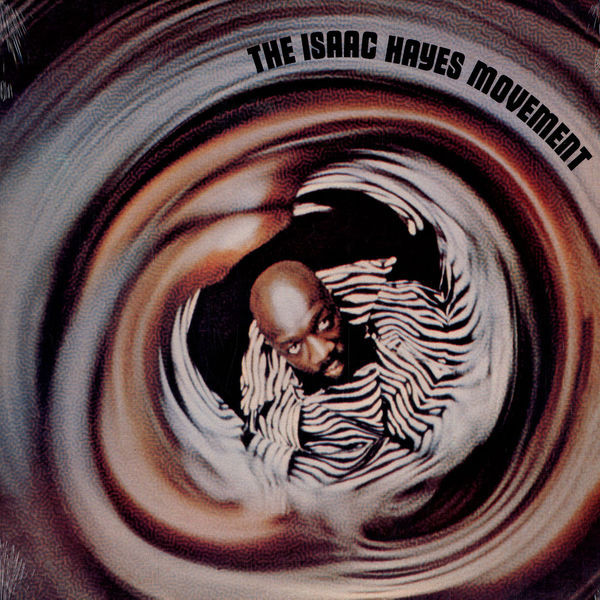
Album of the Week: The Isaac Hayes Movement (1970)

Isaac Hayes released a whopping 6 albums between the 4 years of 1968-1971, including the double-albums Black Moses and Shaft. All the albums are worth seeking out, and I’ve previously covered his excellent debut from 1968. The young artist followed that up with Hot Buttered Soul, his magnum opus, and in 1970 released his third LP, The Isaac Hayes Movement.

Hot Buttered Soul standout “By the Time I Get to Phoenix” is echoed here on Movement‘s opener “I Stand Accused”. The grand narrative buildup, the orchestral accompaniment and the arresting performance of the song make this track nearly as good at nearly 12 minutes. The epic buildup pays off as ol’ Ike, brimming with emotion, rattles off “I love you”s to his unrequited love. Similar in length is the closer “Something”, a take on George Harrison’s classic contribution to Abbey Road, though it fails to beat the Beatles version. The album is filled out with “One Big Unhappy Family”, as bitter in lyrics as it is sweet in sound, and the downbeat “I Just Don’t Know What to Do with Myself”.

I was walking to work in Philly one day, about 2 years ago, when I found a stack of records abandoned on the sidewalk. Among them were gems like Superfly and this Hayes album (which has a sick insert that hangs on my wall). Though it seems to get overshadowed by some of his other work, Isaac Hayes Movement is classic material from the artist at his peak.

Listen to The Isaac Hayes Movement here.

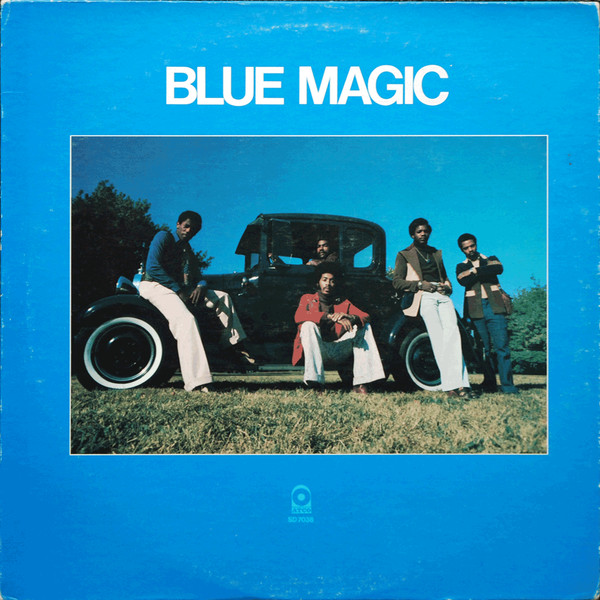
Album of the Week: Blue Magic’s s/t (1974)

Five wonderful, outta sight, and talented guys -back cover of Blue Magic LP release

Open your mind, you see the circus in the sky -Jay-Z, “Blue Magic”

Philadelphia is one of the 20th century Meccas of soul music. The super-producer group MFSB, which included master R&B architects like Thom Bell and Dexter Wansel, convened at 212 North 12th Street in the 70’s to record “The Sound of Philadelphia” (which became the Soul Train theme) and other classics by writing team Gamble & Huff (“Love Train”, “If You Don’t Know Me by Now”). Punchy and orchestral, these soul innovators practically invented their own genre.

My interest in Philly Soul began in 2015 when I heard The Stylistics, which remains the subgenre’s high-water mark for me. A year later I found Blue Magic. For a long time I returned only to the mammoth side-A closer “Just Don’t Want to Be Lonely”. But listening to the album today, it strikes me as remarkably solid, an album with no lowlights to speak of.

Compared to The Stylistics, Blue Magic is lesser known. They only nabbed one top 10 Billboard hit in their careers, with Blue Magic opener “Sideshow”, but this is a true gem of a song. Straight away, lead singer Ted Mills lends his delicate falsetto to the beautiful track, which is as heartbreaking as it is catchy. “Sideshow” (and “Just Don’t Want to Be Lonely”) co-writer and session guitarist Bobby Eli had by this point played with the O’Jays, Stylistics, B.B. King and more, and his presence is important here (he would continue to work with Blue Magic on their next 3 albums). Norman Harris was, similarly, an MFSB guy, and his “Look Me Up” is an energetic contrast to the album opener.

But where Blue Magic succeed best is in their delicate, heavenly ballads. “What’s Come Over Me” sounds more like a daydream than anything else I’ve heard in the Philly Soul oeuvre. “Spell”, the band’s first single, is tender almost to a fault (inspiring a great Rateyourmusic user comment: “spell makes me shed dove tears bro”). “Just Don’t Want to Be Lonely” is epic in scope, extending over 7 minutes with a full spoken-word breakdown. Everything is meticulously composed, scrupulously played and sang. Just incredible stuff.

I’ll be checking out the follow-ups to Blue Magic to see how they measure up. In the meantime, I recommend getting acquainted with this standout soul record.

Listen to Blue Magic here.

Album of the Week: Bloodstone s/t (1972)

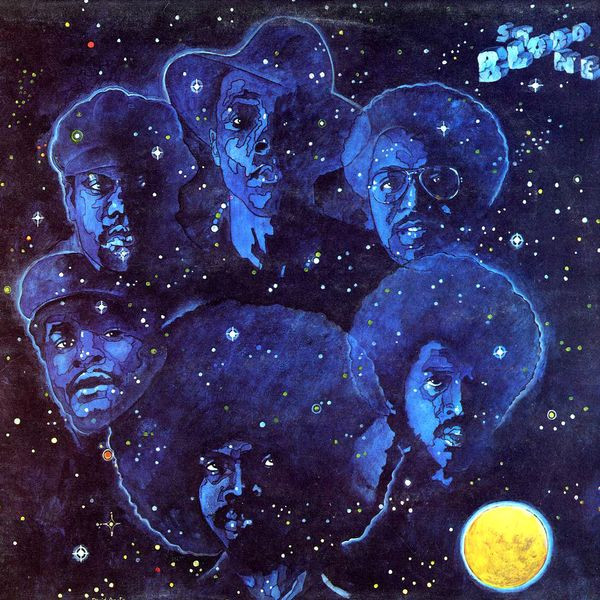
Bloodstone started in Kansas City in the early 60s as a junior high singing quartet started by Harry Williams, which became The Sinceres. While The Sinceres they never released an album, you can find their excellent single “Don’t Waste My Time” on Spotify. Moving to LA as Bloodstone, they recorded and released this excellent debut for Decca.

Bloodstone is a tight mix of classic 60s R&B and dirty 70s funk. I love the electric guitar on this record. While opener “Sadie Mae” is not necessarily a killer song, the band makes up for it with their ripping guitars. The centerpiece here is the lone cover song, “Little Green Apples”, written by Bobby Russell and performed by several artists including O.C. Smith, who hit #2 on Billboard with his version. Whereas Smith’s version was about 4 minutes, Bloodstone kick it into epic territory with a 9 minute take. The pre-chorus (“If that’s not lovin’ me…”) is magically drawn out, and the falsetto backing vocals make the track. This is a killer soul deep cut.

The B-side starts with “This Thing is Heavy”, an outsider’s take on the bourgeoning world of recreational drug use (“What’s this thing, people talkin’ bout ‘let’s get high’?”) “Lady of the Night” is a funky rave-up with some excellent rhythm guitar. Next to “Little Green Apples”, closer “Dumb Dude” might be my favorite track here. It starts out as an almost dirge, with Bloodstone’s vocal-group roots showing in vocal harmonies. Then the track finds a more upbeat groove in its final 2 minutes, with a killer guitar tone. Wonderful ending to a tight album.

Bloodstone would go on to record their biggest hit as the title track of their sophomore record, Natural High. Somewhat oddly, the entire B-side of Bloodstone was released on the CD (and now streaming) version of their third LP, Unreal, which is also a winner. But for a place to start, Bloodstone comes with my high recommendation.

Listen to Bloodstone here.

Album of the Week: Curtis Mayfield’s Sweet Exorcist (1974)

We love Curtis Mayfield over here at GSG. Curtis, Roots, Superfly – all stone-cold classics, not to mention There’s No Place Like America Today, my personal favorite of his. A few of his albums slipped through the cracks though, including Sweet Exorcist.

A 1974 review in Rolling Stone complains that the album “sounds hastily conceived and then competently executed to meet some contractual deadline.” Christgau gave the album a C and wrote that “To Be Invisible” is “its only interesting song.” Was Sweet Exorcist deserving of its lukewarm reception?

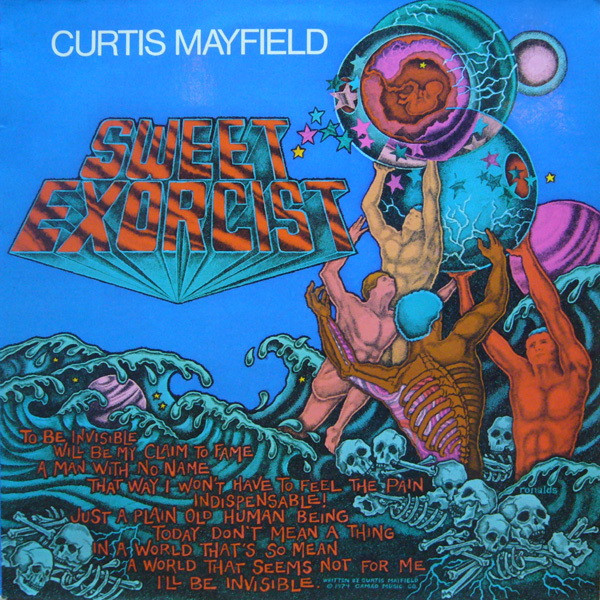
Well, yes and no. Compared to earlier outings from Mayfield, it’s a step down. But once you’ve listened to those records innumerable times, this one comes as something of a fresh discovery. It’s certainly not as weird as the cover would suggest – and seriously, what is going on here? Naked blue-haired men rising from a skeleton sea to lift up the planets and an electrified embryo? I’m not sure if this cover helped or hurt sales.

But the contents are, for the most part, classic Curtis. The title track grooves and “To Be Invisible” is a damn good ballad. While “Power to the People” is a bit rote and “Kung Fu” is lyrically silly, the rest are solid tracks. “Suffer” has a co-writing credit from Donny Hathaway and is accordingly heartfelt. “Make Me Believe in You” ends things on a strong note with a driving beat.

At just over half an hour, Exorcist feels a little slim. Who knows, maybe it was indeed executed to meet some contractual deadline. Nevertheless, we have in 2022 the convenient ability to instantly stream this music instead of going out and buying the record, weird-ass cover and all.

Listen to Sweet Exorcist here.

Album of the Week: The Intruders’ Cowboys to Girls (1968)

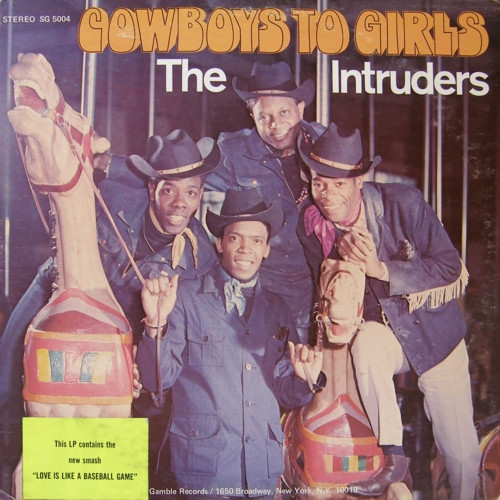
Remember as a kid when you used to chase girls and beat ‘em up? What? You don’t? Well, me neither actually. But this is a strange memory of the narrator in “Cowboys to Girls”, a lush dream of a track from The Intruders, an R&B group and early musical project for Philadelphians Gamble & Huff.

Though they would go on to write and produce bigger and better tracks, like “Love Train” and “Me and Mrs. Jones”, Gamble & Huff’s work on Cowboys to Girls has its own breezy charm. Reportedly from North Philly and led (originally) by the smoky voice of Sam “Little Sonny” Brown, The Intruders straddle the line between the harmony-heavy doo-wop of the early 60s and the smooth soul of the early 70s.

“Turn the Hands of Time” recalls The Supremes or Jackson 5 in its ecstatic chorus. Clocking in at under 2 minutes, “Sad Girl” is (perhaps too) short and sweet, rounding out the first side. In the second half we have the quite corny, yet cute “(Love Is Like A) Baseball Game”. Not really as great a metaphor/song as “Heat Wave”, but they can’t all be classics. I do like this brief version of “By the Time I Get to Phoenix”, which, although originally performed by Glen Campbell, I most associate with Isaac Hayes’ mammoth 18 minute version.

The Intruders would go on to release several more albums, which I have not yet heard at the time of this rating. But I recommend Cowboys to Girls to any soul/R&B fan looking for something slightly obscure (it is difficult even to find a high-res upload of the album cover) yet very smooth.

Listen to Cowboys to Girls here.

Album of the Week: James Brown’s There It Is (1972)

The Godfather of Soul has an overwhelmingly huge discography, and I’ve heard relatively few of his studio albums, live albums or compilations. The guy basically invented funk music, and many fans point to records like Sex Machine and The Payback as essential collections of his energetic funk mastery.

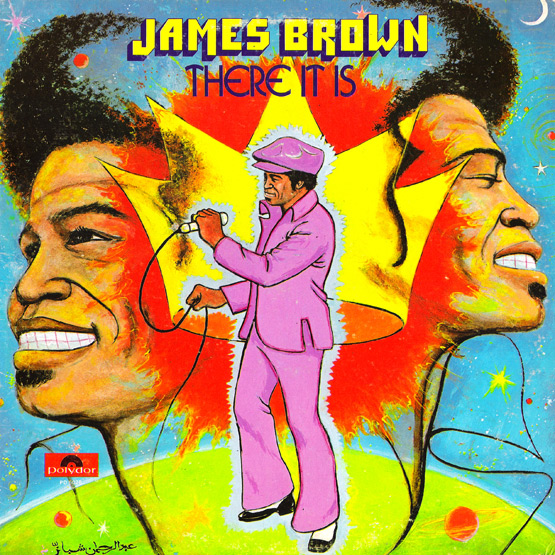
There It Is is a bit different. It contains some tracks that are outside the sound of James Brown’s typical oeuvre. “King Heroin” is amazingly surreal: over a laconic groove, Brown describes a dream about a “strange weird object” talking to people. Turns out it’s heroin, and Brown (as the anthropomorphic heroin) recites the dangers of the deadly drug. This one must be heard to be believed! Ultimately, James Brown’s anti-drug PSAs feel hypocritical, as he would go on to abuse PCP and other drugs for years. “Public Enemy #1” follows the example of “King Heroin”, but packs less of a punch.

There are a few classic funk cuts here, most notably “Talkin’ Loud and Saying Nothin'”, “I’m a Greedy Man” and the title track. “Who Am I” is a rare James Brown ballad, and his voice isn’t exactly tailor-made for the style. Nevertheless, I like it. The closer “Never Can Say Goodbye” has a laid-back beat similar to “King Heroin”, but there’s no proselytizing on this song. It’s a nice way to end a strong outing from the prolific James Brown.

Listen to There It Is here.