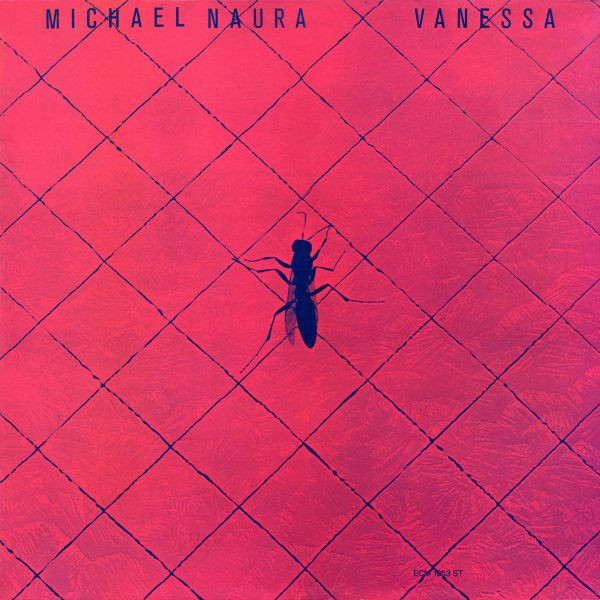
Recently I discovered Michael Naura Quartet’s Call (1973) and fell in love. Born in Lithuania, the pianist Naura moved to Germany and released music on the German label MPS. Call featured longtime bandmates Wolfgang Schlüter on vibraphone and Joe Nay on drums, as well as upright bass extraordinaire Eberhard Weber. For Vanessa, his ECM debut, Naura’s band is augmented to a quintet with a bassoonist in Klaus Thunemann.
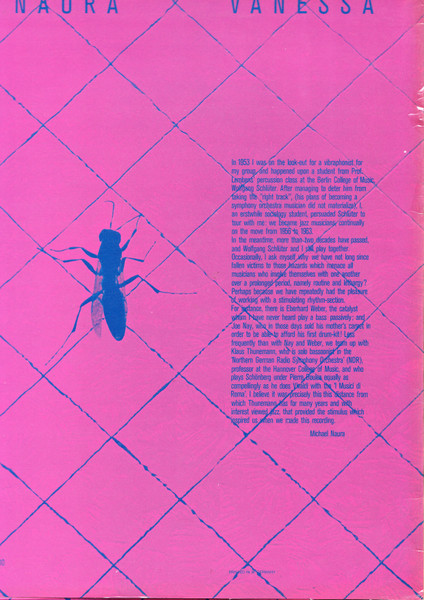
As Naura notes on the album’s back cover, he had by 1975 been playing jazz with Wolfgang Schlüter for two decades, and listening to several of their albums it is hard to understate the presence of Schlüter’s vibes, which seem to highlight Naura’s recordings more than even Naura’s own instrument. Still, Naura’s writing, presence as bandleader, and ability to establish the mood of his tracks is palpable. It is the element of this core duo, with Naura’s calm rhythms and Schlüter’s colorful leads, that makes Naura’s albums so compelling. Weber, the biggest name in the group, and Joe Nay, who according to Naura’s liner notes “[once] sold his mother’s carpet in order to be able to afford his first drum-kit,” fill out the rhythm section.
All that said, the first thing you really notice on Vanessa is a bassoon. Klaus Thunemann was a classical soloist and a Vivaldi specialist who really knew his way around the woodwind (and still does, I’m sure). His bassoon vamp over a murky groove on “Salvatore” makes the song a level-up from the band’s (bassoon-less) sound on Call. Around 8 minutes in, the drums drop out, and then Thunemann plays notes that sound like feedback. It’s amazing! After this nearly 12-minute opener, Weber, himself an ECM mainstay, spends most of the brief “Hills” just absolutely getting it in. “Vanessa” itself is a beautiful track – consisting mostly of just piano and vibraphone, it’s a reverie. Naura and Schlüter’s dynamic partnership is especially present on “Listen to Me”, where they really push each other. Thunemann’s track, the closer “Black Pigeon”, finds him rounding out the last 2 minutes of the record with eye-popping skill.
I believe this is the only recording of Naura or Schlüter with Thunemann, which is a shame, because he added another dimension to Naura’s band that makes Vanessa really superb. You can find some of Thunemann’s classical work here, and I also recommend the Naura Quartet’s spacier outing Rainbow Runner (1972).
Listen to Vanessa here.

 good singing gum